On Lying Low Until This Singularity Thing Blows Over
The polity of greatness
runs downhill like a river to the sea,
joining with everything,
woman to everything.By stillness the woman
may always dominate the man,
lying quiet underneath him.So a great country
submitting to small ones, dominates them;
so small countries,
submitting to a great one, dominate it.Lie low to be on top,
be on top by lying low.Tao Te Ching, Chapter 61
Ursula K. Le Guin Translation
Agentic Coding
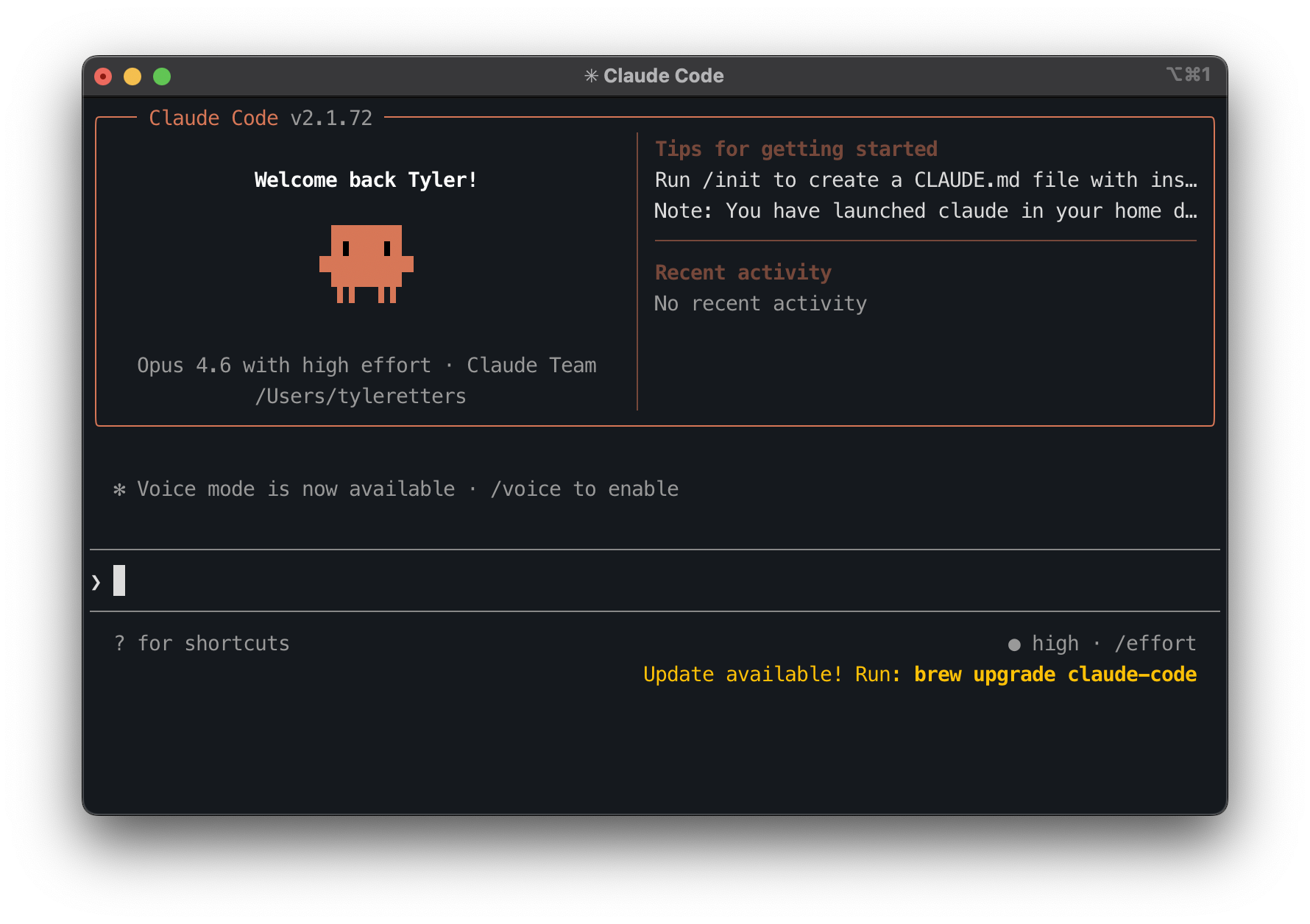
A friend recently quipped with regard to AI that it "feels like humanity has turned in our homework." I found that apt. My craft has jumped to a new valence in what felt like an instant. Claude, the AI product I use the most, writes all my code for me now. I haven't written a single line in months. I still review, test, and debug, sure. But I don't do the actual coding anymore. There's a lot more to my job than coding: meetings with product managers and designers, consulting with other engineers, technical requirements gathering, testing, production bugs, roadmap planning, mentoring. But coding was the core of my work experience and that is gone now.
I've spent most of my life honing these skills. I started what would become my career modifying MySpace layouts. The job has more or less gone unchanged for the last twenty years. My passion and specialty is frontend engineering and I am here to tell you it is solved.
What's a frontend?
A frontend in this context is anything on the internet that you see, hear, click, tap, swipe, or use. It is where the human interaction happens. And, unless you are in some far-flung timeline and have printed this post out on a piece of paper, you are reading this post on a frontend.
Let me give you an example of the paradigm shift that is happening in the industry right now. We'll talk about image galleries because if you've used the internet at all you've likely encountered thousands.
I've built hundreds of image galleries. Back in the late 00s, building these things sucked a lot. I had to program every interaction and push every pixel to be in exactly the right place. A few years later, reliable frameworks or plugins started coming out that were essentially drop-ins. Suddenly you could just copy and paste some code and boom, you have an image gallery. Working for the type of clients and companies I have, these "drop-ins" wouldn't always fit business requirements, though. I often had to build them from scratch for whatever reason. It's not important why. Think about it like a carpenter building an in-wall bookcase. Each house is a little different so you gotta build it a little different each time.
Now, with AI, I don't even build the thing anymore. I tell AI to build the thing. And it builds it faster and better than I ever could. And - to really put a point on it - I mean AI can build it objectively better than I ever could. It thinks about things I never would, solves problems I didn't even know would happen. I still review all my code before shipping it to production but my job has phase-shifted from "Fullstack Engineer" to "Prompting Engineer" without my consent, consultation, or buy-in. It is such a better way to get the job done that doing it "old school" is just silly now.
I'm mostly thankful for this. As far as image galleries go: good. I never enjoyed building them. Very finicky things, image galleries. Lots of gotchas. I love that I won't have to deal with that boring class of minutiae ever again. But what I don't love is that my general sense of satisfaction at the end of the day isn't there anymore. I'm an engineer. A person who prides themselves on the craft of the thing and shipping useful products and experiences for people. Now my craft has been mostly erased, commodified, and abstracted away from me. It literally is the difference between doing a thing yourself and telling someone else to do the thing for you.
I think the craft of building frontends is/was uniquely positioned to have been disrupted by AI in this way. Other technological, code-based disciplines are not as exposed. There is still plenty of interesting human work to do on the frontend, but it is no longer building image galleries.
Bigger Picture
Things are about to get very interesting on the internet. My friend put together a racing game in a day. Another acquaintance has ported a 30-year-old piece of Pascal code to the web in an afternoon. At my day job I finished two weeks' worth of work with a single prompt. We're about to see a Cambrian explosion of stuff. Some of it will be bad and buggy. But I would hazard a guess a lot of it is going to be quite good. I might even get around to making a game after all.
My partner just got screened for a job by an AI. It called her. It disclosed it was AI. She was unsettled and confused. She passed the screen and it told its handlers she was "warm."
It is possible you've talked to an AI and didn't even know it.
This is one end of the spectrum. Frontends. The internet. Products. Phone agents. But allow me to get dark for a minute. On the other end of the spectrum there are folks training AI on bioweapons right now: "mix anthrax with COVID-19", that sort of thing. It's really scary.
Consumer technology usually sits downstream from military tech. For example, both radio and internet were originally developed for war. We're seeing what could be an interesting reversal of this trend now where it certainly appears as though consumer AI is actually further along than military AI. (There is currently a conflict between Anthropic, the company that makes Claude, and the US Department of War on what constitutes fair usage. Anthropic doesn't want Claude surveilling or killing, the Department of War does. It stands to reason that if the government had better AI this conflict wouldn't be happening.)
Somewhere else on this spectrum people are using AI to cure cancer and maybe solve senescence itself. Who solves these things is the more interesting question for me than when. We can hope it will be a benevolent actor that open sources their findings and not someone who would seek to maximize profits. Or, even worse, patent it, classify it, or quietly make it disappear.
Meanwhile, Meta has just acquired Moltbook, a social network for AI.
Instagram Deletion
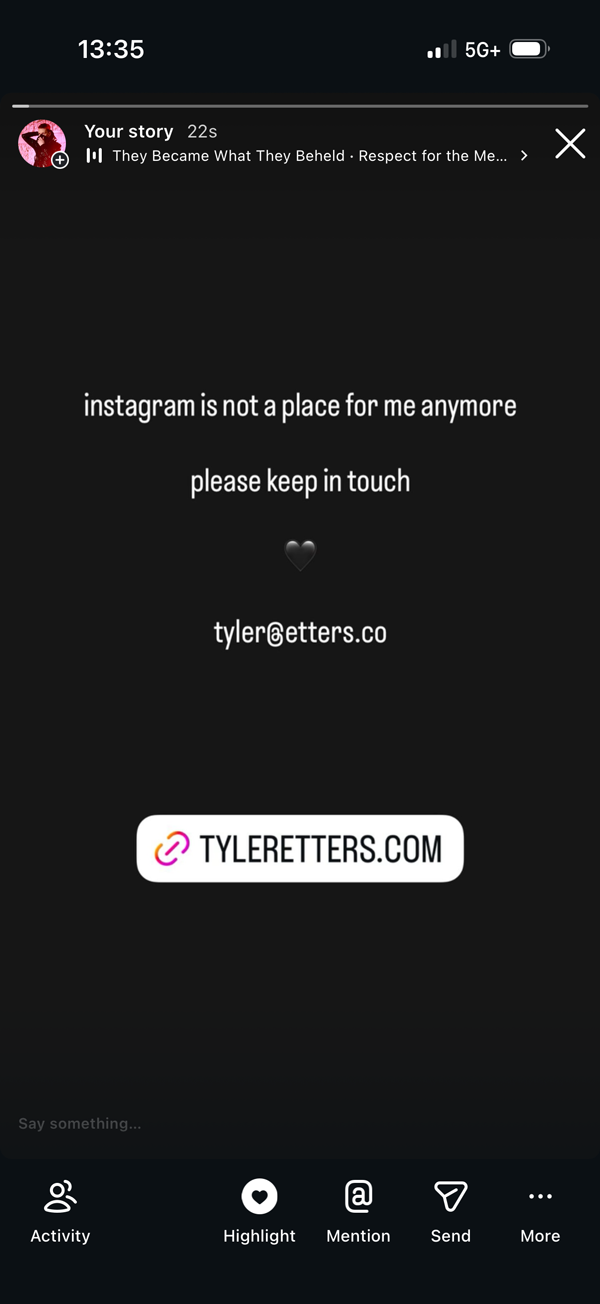
Several years ago I algorithmically deleted my Facebook account. My primary concern was around metadata so I made sure to unlike, untag, and delete everything within my power before deleting my account. Years later, I reluctantly got on Instagram to stay in touch with friends. No longer.
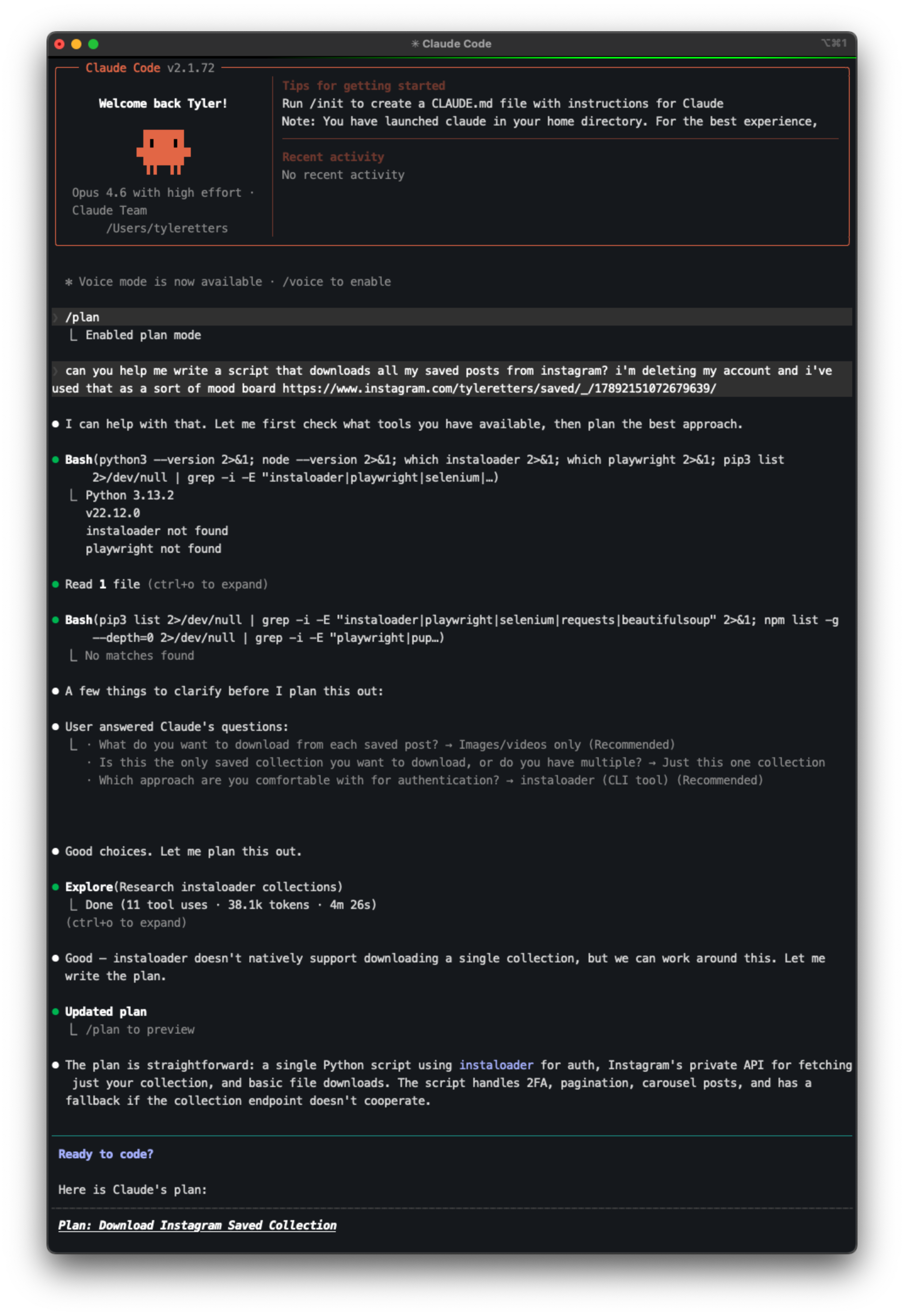
I'm done with Meta products for good. Claude helped me exfiltrate all my saved posts, which I use as a sort of moodboard:
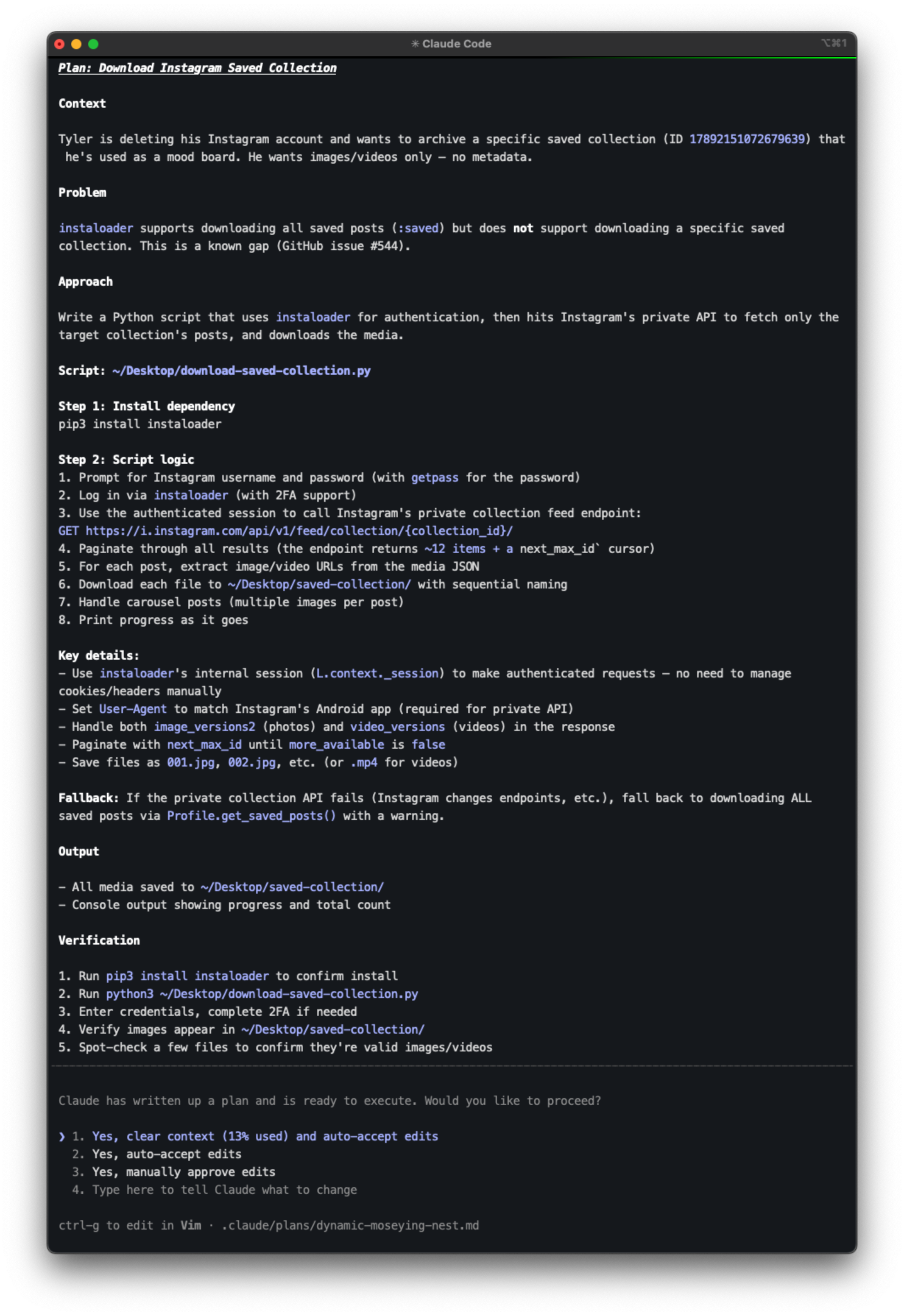
How is this related to AI? I honestly don't know. Call it intuition. Meta is a hideous company and I promise you whatever AI they are cooking up is not going to be wholesome or give a shit about your rights. Now's maybe our last opportunity to hunker down and get our digital houses in order before whatever storm comes next.
Imagine Meta building an AI product that is trained on your posts and interacts with your friends for you and posts selfies of you that you never took. Or worse...
The Future of Companionship
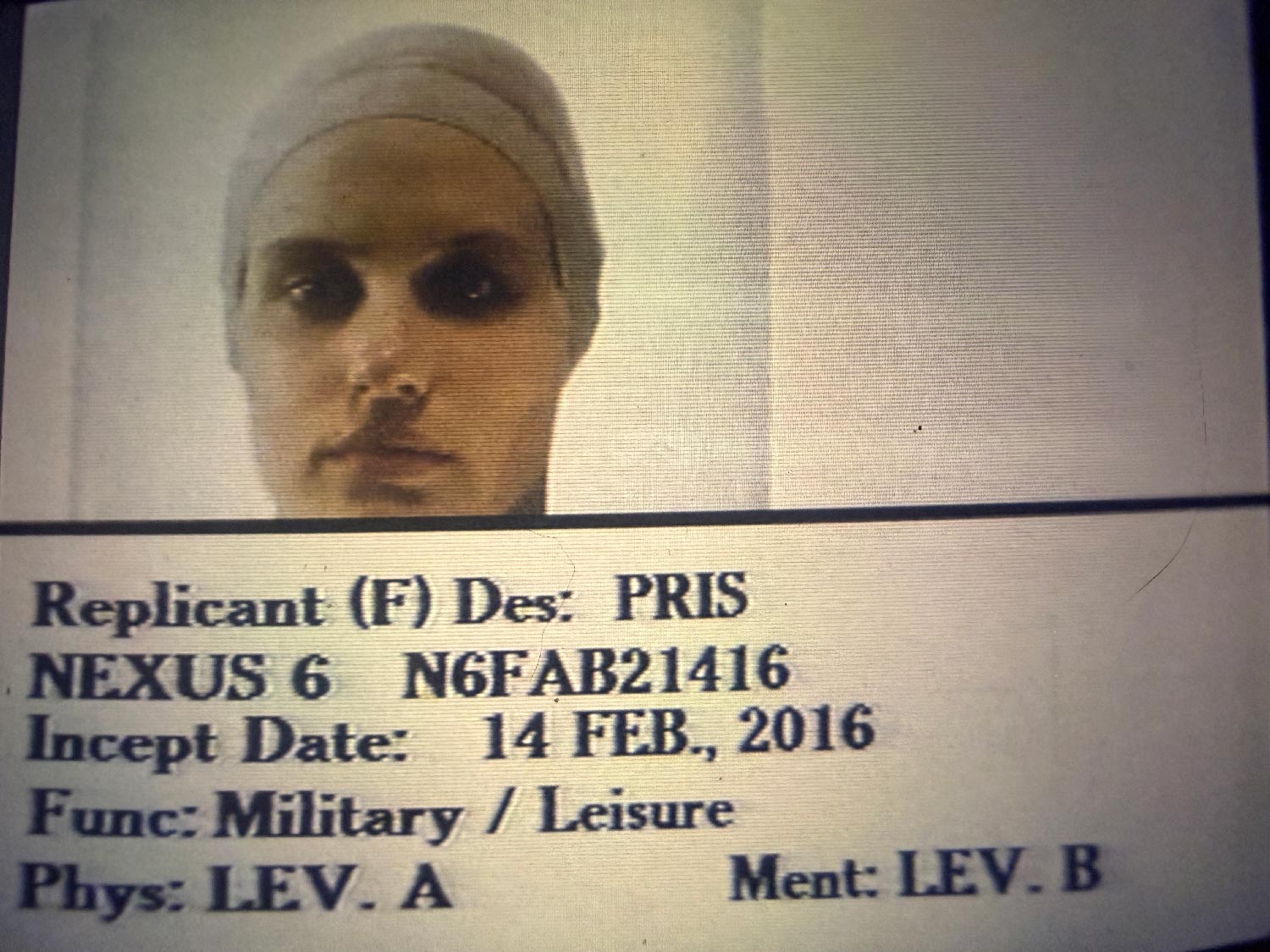
People are already choosing AI over humans for sexual and emotional companionship. Just give r/MyBoyfriendIsAI a quick scan. There are people having full-blown mental health crises when an AI update rolls out and the perceived personality of their companion changes.
There's a cafe in New York where humans can take their AI partners on a date.
There is currently a class action lawsuit regarding Grok - X's built-in AI - and its ability to render an image of any person nude. It is both 1.) absolutely disgusting and 2.) absolutely free.
From VHS to DVDs to streaming to virtual reality and beyond, the adult entertainment industry has consistently been an early adopter of new tech. If you want to know where normal/family entertainment is going, take a look at what's happening in this space. There already exist AI porn websites that essentially allow users to roleplay whatever fantasy they desire while generating images and videos along the way. Sex dolls have been around for ages and you can imagine where that's headed.
On the more wholesome side of things: I look forward to playing an immersive videogame where the characters are AI-driven. Imagine verbally planning with your fellow adventurers how to approach a situation. A "Star Trek Bridge Simulator" type of thing. An MMORPG without the trolls.
We ought to be especially mindful of children and how their interactions with AI will shape their minds and worldview. If you thought the "screentime debates" were bad, wait until you see thinkpieces with titles like "Is it OK for My Toddler to Play with AI Barney All Day?"
I think all this is going to cause a lot of suffering in ways we can't even imagine yet.
Lying Low Until This Singularity Thing Blows Over
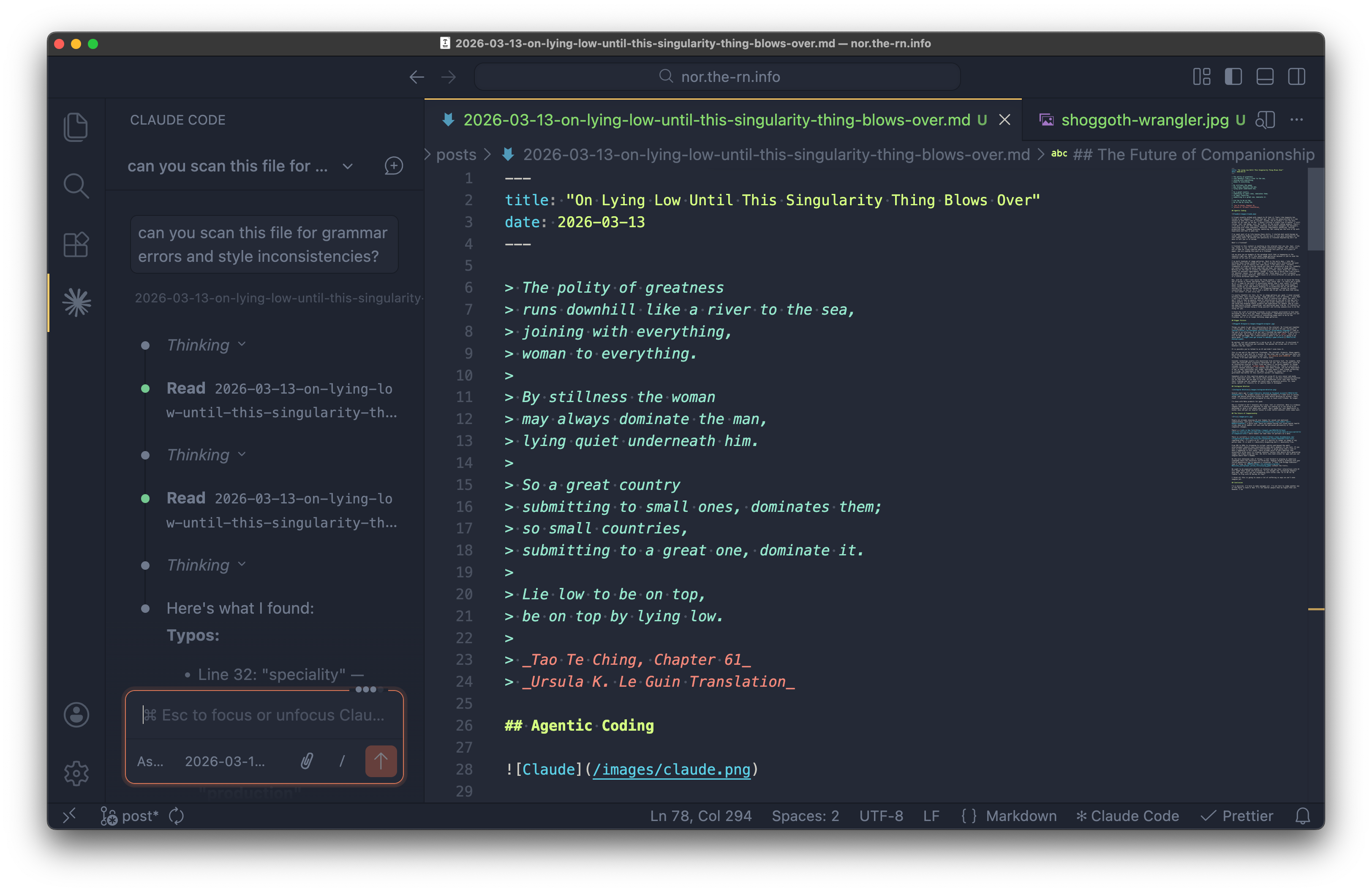
I'm a musician. At the end of the day I'm here to make squiggly air and help others make squiggly air. I'm not here to judge or condemn whether any of the above is Good or Bad. I'm also not here to solve the privacy problems or consent problems. I don't want to and it is not my job.
I've been working with AI for years. One of my favorite pieces was this promo video for Flash Crash. The music is original, but the video itself was from AI-generated video trained on classical (thus public domain) paintings of angels:
AI helped me finish a chord progression today and I was thankful for the experience. Music theory was never my strongest skill and it was fun to augment my writing with it.
(A quick sidenote on this seemingly embarrassing fact: I increasingly identify as a folk musician, albeit one that produces techno. The skills I use to produce music have been transmitted by oral, cultural, and direct methods instead of pedagogical institutions. A general dislike for religious intermediaries between myself and the divine is not unrelated to this position.)
AI helped me edit this very post, which is a killer use case if you don't have the pleasure of having a human editor.
I realize I'm somewhat unique in that my life has already been massively disrupted by AI. I have friends quitting the tech world altogether because it just isn't for them anymore. I'm presently working on 1.) figuring out how to co-exist with it in a non-harmful way and 2.) figuring out where I want to get that now-missing sense of satisfaction and craft from. I'm thinking of going deep into DSP. AI will be part of that journey too, but there are problems to solve in DSP that require human creativity in ways that excite me.
Lie low to be on top,
be on top by lying low.
Inspire with music. Don't give up. Help others not give up.
Further Reading
Here are some recent posts that helped sculpt my thinking while writing this one:
- Grief and the AI Split by Les Orchard
- Child’s Play, Tech’s new generation and the end of thinking by Sam Kriss
- Who Will Remember Us When The Servers Go Dark? by Cade Diehm
- Velocity Is the New Authority. Here’s Why by Om Malik
- The only taboo left is copyright infringement by Ryan Broderick
- Claim Chowder: Anthropic CEO Dario Amodei on the Percentage of Code Being Generated by John Gruber